Steam Showers and What a Real Spa Bathroom Requires
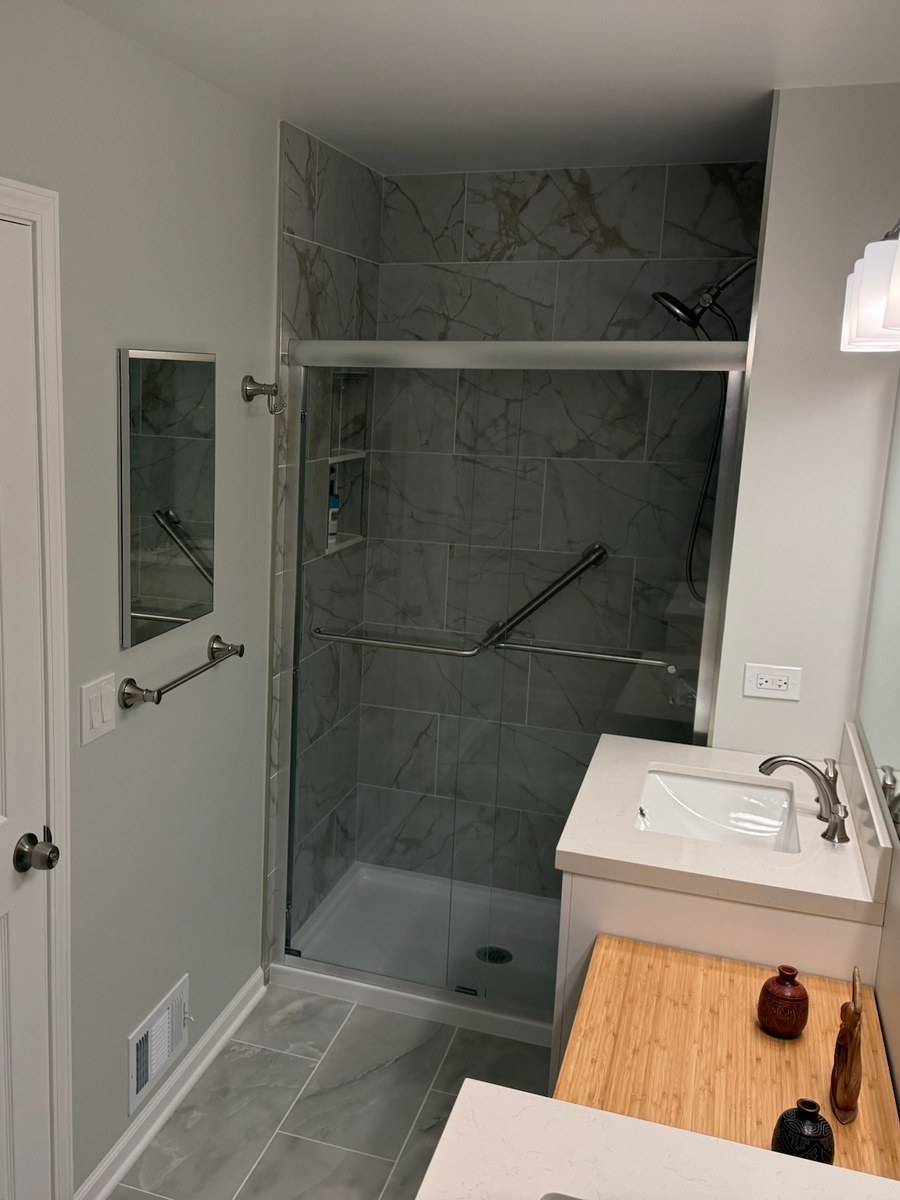
Vapor barrier on all six surfaces, a sloped ceiling, a correctly sized generator. What a steam shower actually takes, what it costs, and the comfort upgrades worth more than the tile.
A rainhead and a bench do not make a spa. What makes a bathroom feel like one is heat: warm floors, warm air, and a shower you do not want to leave in February. In the Chicago suburbs that is a very specific list of construction details, and most of them happen before a single tile is set.
“Can I put a real steam shower in my primary bathroom?”
In most homes, yes, and it is one of the few luxury features that genuinely changes daily life rather than just the listing photos. At ADS Building & Remodeling we build these for homeowners in Buffalo Grove, Arlington Heights, Glen Ellyn, Naperville, Wheaton, and Schaumburg. Here is what a steam shower actually requires, what it costs, and where people get it wrong.
Why a Steam Shower Is Not Just a Nice Shower
A steam enclosure is a sealed, vapor-tight box. Ordinary showers let moisture escape and dry out between uses. A steam room holds saturated air at 110 to 120 degrees and pushes it into every joint, every seam, and every square inch of substrate. Build one the way you build a normal shower and the wall assembly fails, usually within a few years, usually in the ceiling.
That is why steam work is quoted differently. You are paying for an assembly, not a fixture.
The Five Requirements
A Continuous Vapor Barrier on All Six Surfaces
Four walls, floor, and ceiling get a continuous impervious membrane before substrate and tile. The tile industry guidelines are explicit about this. Cement board or another cementitious backer goes over it. Moisture resistant drywall, the green stuff, is not acceptable in a steam enclosure and we will not build one on it.
A Sloped Ceiling
Steam condenses on the ceiling. If that ceiling is flat, the condensation drips straight down on whoever is sitting under it. The tile industry recommendation is a minimum slope of about 1 inch per foot, and 2 inches per foot is what we prefer, so water runs to a wall and down instead of onto your head.
A Correctly Sized Generator
Generators are sized to the enclosure volume, roughly 1 kW per 45 to 50 cubic feet as a starting benchmark, then adjusted upward for stone, for glass, and for ceilings above 8 feet. Natural stone in particular absorbs a great deal of energy and needs a bigger unit than the same room in porcelain.
Electrically this is real work: a 7 to 10 kW unit typically needs a dedicated 30 amp circuit, larger units up to 60 amp. The generator itself lives in a nearby closet, vanity base, or ceiling space, and it needs access for service. Building one in with no access panel is a mistake we get called to fix.
A Door That Seals, and a Bench That Drains
Full height glass to the ceiling with a proper seal, hinged to swing out. Benches get sloped about a quarter inch per foot so water runs off rather than pooling under you.
Ventilation for After
A steam room needs to dry out between sessions. That means a fan sized for the space, on a timer, venting outside. Without it you have built a chamber that stays wet, and wet chambers grow things.
What It Costs in the Chicago Suburbs
Converting an existing shower to steam during a bathroom remodel: typically $4,000 to $10,000 above the cost of the tiled shower itself, covering the generator, the electrical, the vapor sealing, the sloped ceiling, and the glass upgrade.
A custom steam enclosure inside a full primary bath rebuild: the bathroom itself usually lands between $35,000 and $70,000, with the steam package inside that number.
The generator alone is often the smallest line. Most of the money is in the assembly and the labor that makes it last.
The Rest of the Spa List, Ranked by Value
- Heated floor. $900 to $2,000 in a typical primary bath. If you only do one thing on this list, do this one. It is the feature clients mention years later.
- Heated towel bar, hardwired, roughly $400 to $1,200 installed. Small, absurdly pleasant in a Chicago winter.
- Layered light on dimmers, including a very low night setting. A spa bathroom lit at full brightness is just a bathroom.
- Thermostatic valve with volume control, so the shower comes on at the temperature you set, every time.
- A niche that was planned, lined in the same slab as the walls, lit from above. This is where the eye goes.
- A freestanding tub only if you actually bathe. We build a lot of them. Half get used twice a year. Be honest, and if the answer is no, spend the money on the shower.
Where Luxury Bathrooms Go Wrong
Almost always the same three things. Ventilation sized for a powder room, so the room never dries. Stone chosen without asking about porosity, so it stains in month two. And glass ordered as an afterthought, in a thickness and configuration that fights the layout instead of disappearing into it.
None of these are budget problems. They are sequence problems, decided before drywall, by whoever is thinking ahead.
Common Questions
How long does the steam take to be ready?
A properly sized generator brings the enclosure up in about 10 to 15 minutes. Many systems have a scheduling feature, which is genuinely useful if you shower at the same time each morning.
Does it raise my water or energy bill much?
A steam session uses roughly a gallon or two of water and runs the generator for a few kilowatt hours. It is a modest number compared with a long conventional shower.
Does a steam shower help resale?
In this price range, it reads as a serious upgrade, especially in a primary suite that has already been rebuilt well. It is not a feature that pays for itself on paper. It is a feature you build because you will use it four times a week for a decade.
Important Cost Note
These are planning ranges, not quotes. Volume, ceiling height, stone selection, and the electrical path all move the number. At ADS the in-home consultation, the design conversation, and the 3D rendering are complimentary.
Planning a Primary Bathroom?
If you are rebuilding a primary bathroom in Buffalo Grove, Arlington Heights, Glen Ellyn, Naperville, or a nearby Chicago suburb, bring up steam at the design stage. Retrofitting it into a finished bathroom means starting the shower over.
At ADS Building & Remodeling, we provide:
- A complimentary design consultation and 3D rendering
- Steam enclosures built to tile industry standards, with a flood test before tile
- A fixed-price quote that doesn’t move after you sign
- One accountable team, permits, inspections, and project management from demo to final walk-through
Luxury in a bathroom is mostly heat, quiet, and things that work every single morning. The rest is finish.