
Quartz or Quartzite? Choose a Countertop by the Care You Want
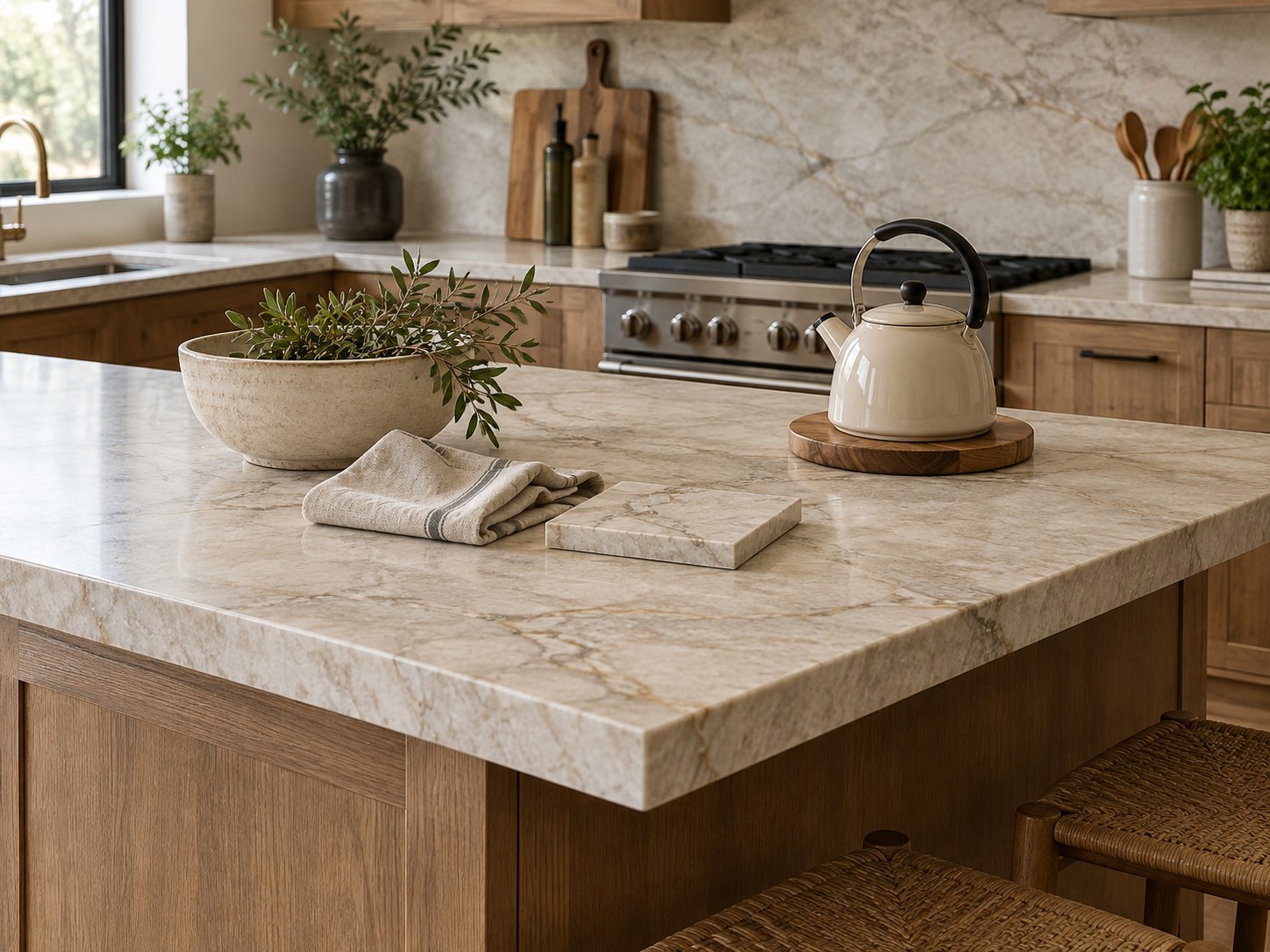
Quartz and quartzite need different care conversations. Compare samples, heat precautions, sealing guidance and fabrication details before choosing a slab.
Which countertop will be easier to live with after the showroom excitement wears off?
Quartz and quartzite are often compared because their names sound alike and both can offer a pale, stone-like appearance. They are different material categories. For a kitchen remodel in Buffalo Grove or Naperville, make the decision with a specific product or slab, its care instructions and the proposed fabrication details in front of you.
Short answer. Quartz and quartzite are different materials: quartz countertops are engineered products, while quartzite is natural stone. Compare the actual slab or product, its care instructions, heat precautions and fabrication scope before choosing by the name alone.
Begin with the material’s identity
Engineered quartz products combine mineral content with binders and other ingredients; natural quartzite is a stone. Ask the supplier to identify the exact material and finish on the written selection. A display label or an attractive trade name should not be the only record of what you are buying.
Do not assume every product within either category behaves identically. Review the manufacturer’s or stone supplier’s guidance for that selection. If a sample is available for evaluation, ask what checks the supplier recommends and what the sample can reasonably demonstrate.
Read the care sheet before approving the surface
As one manufacturer example, Cambria says its quartz surfaces do not require sealing and recommends protection from direct heat. Those instructions apply to its products; obtain the equivalent document for whichever brand you choose.
For natural stone, the Natural Stone Institute advises identifying the stone’s composition and consulting the supplier about cleaning and any sealing needs. It also notes that sealing improves stain resistance rather than making stone stain-proof. Avoid a blanket promise that every quartzite slab needs the same treatment on the same calendar.
Match the choice to your habits
Describe a normal evening in your kitchen. Do hot pans land beside the range? Do children prepare snacks at the island? Does someone leave coffee rings until later? Are you comfortable following a specific cleaning routine? Honest answers are more useful than choosing the material with the strongest adjective on a display.
Plan a convenient place for trivets and cutting boards regardless of the surface. A product described as durable still has care requirements. The best material for your household is one whose instructions you are willing to follow.
Approve the full visual composition
A small sample does not show how a strong vein will cross an island or turn at a seam. Ask to review the actual slab or the manufacturer’s applicable layout process before fabrication. Mark the sink, cooktop and prominent edges so you can see which parts of the pattern remain.
For a waterfall edge or full-height backsplash, review those pieces with the horizontal surface. Ask which pattern relationships are achievable and which are approximate. Do not assume a continuous-looking inspiration photograph describes the fabrication included in your quote.
Compare complete countertop scopes
- Exact material, finish and thickness.
- Edge profile and treatment of exposed corners.
- Seam locations and the review process before cutting.
- Sink and appliance cutouts, including model coordination.
- Required support and responsibility for cabinet readiness.
- Backsplash, removal of old surfaces and plumbing reconnection.
- Care instructions, warranty terms and service contact.
Do not order the surface before the layout is stable
Changing the sink or cooktop after fabrication can be much more consequential than changing a paint color. Finalize appliance models and cabinet drawings before measurement and approval. A larger island also changes circulation and support questions, not only the square footage of stone.
To keep the wider remodel balanced, compare the countertop decision with where to spend and save. A less dramatic surface paired with better lighting and a stronger layout may suit the room more than the most striking slab in the yard.
Questions to take to the slab or countertop appointment
Go beyond asking which material is more durable. Ask how the actual surface will be used and maintained in your kitchen, and make the answers part of the selection record.
- Identity and finish. Record the manufacturer and product for engineered quartz, or the stone selection and finish for natural quartzite. Keep the approved sample or slab photographs.
- Cleaning. Ask for the approved daily cleaner and the procedure for a difficult spill. Do not assume that a cleaner suitable for one counter is suitable for another.
- Heat and sealing. Obtain the product’s heat precautions and ask whether the selected natural stone needs an impregnating sealer and how that is assessed.
- Fabrication. Review seam locations, edge details, sink cutouts and the appearance of adjoining slabs before authorizing cutting.
Cambria’s care guidance says its quartz surfaces do not need sealing and recommends protection from hot cookware. That describes its products, not every surface sold under a similar name. For natural stone, use the Natural Stone Institute’s care guidance together with advice specific to the selected material.
Common questions
Can I put hot cookware directly on either material?
Use the protection specified by the manufacturer or supplier. Do not treat hardness as a guarantee against heat damage.
Is all quartzite maintenance the same?
No. Obtain guidance for the actual stone and finish you are purchasing.
Should I choose from a photograph?
Use photographs to narrow the direction, then approve the relevant physical sample and slab or layout documentation.
Request a complimentary ADS kitchen consultation to coordinate countertops with cabinetry, appliances and the way your family uses the room.
Sources checked September 20, 2026. Confirm current project-specific requirements before construction.