
Building a Real Wine Room in a Chicago Basement
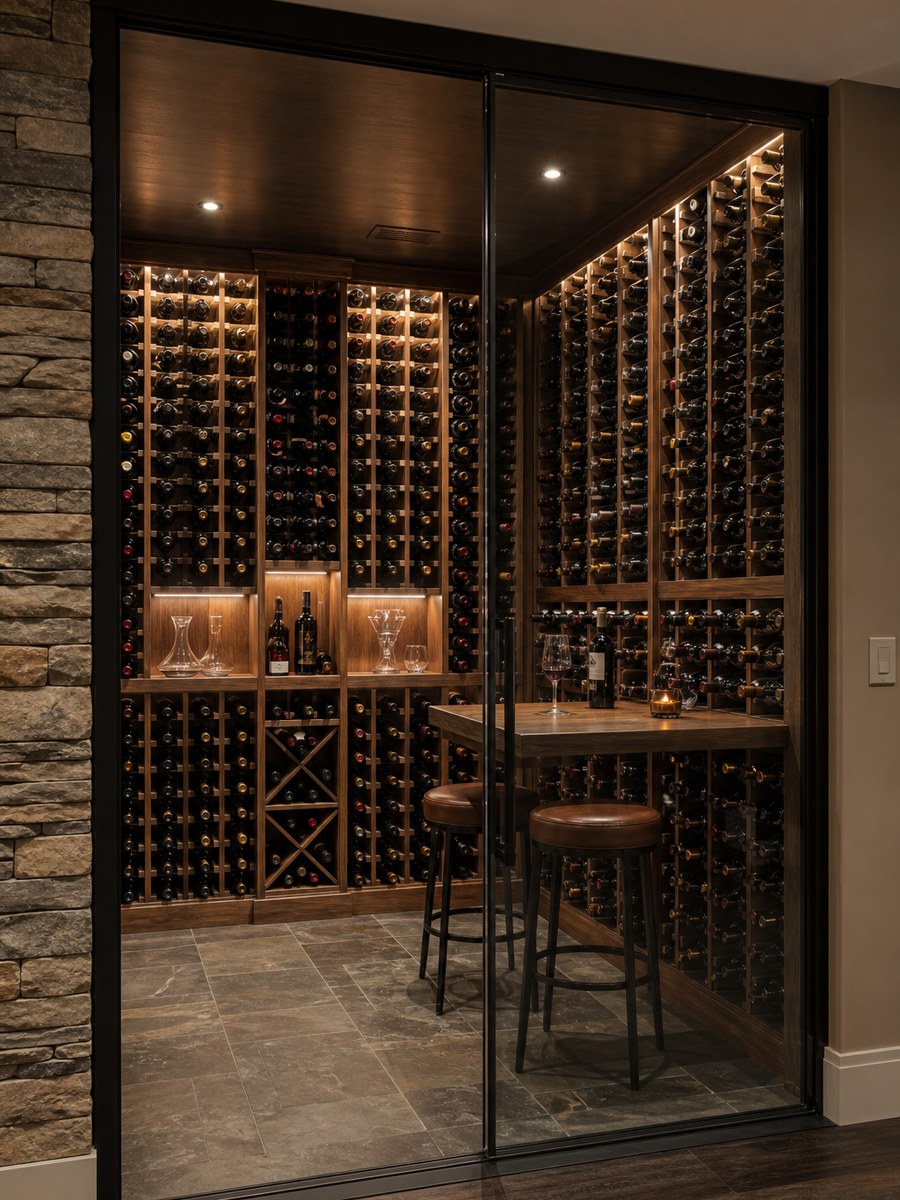
55 to 60 degrees, 60 to 70 percent humidity, and an insulated box with the vapor barrier on the correct side. How wine rooms are actually built and what they cost.
A wine fridge holds bottles. A wine room holds attention. It is the feature guests walk toward, and in a finished basement it turns a rec room into a destination for about the cost of a mid-range bathroom.
“What does it actually take to build a real wine room in a basement?”
Four things: a sealed box, a cooling unit, racking sized to how you actually buy wine, and lighting that treats bottles like objects. At ADS Building & Remodeling we build these into basements in Buffalo Grove, Arlington Heights, Glen Ellyn, Naperville, Wheaton, and Schaumburg, and the construction is more interesting than the shopping.
The Numbers That Define the Room
Wine wants a steady 55 to 60 degrees and relative humidity around 60 to 70 percent. Steady matters more than exact. Swinging between 52 and 68 degrees every day pushes corks and ages wine unevenly, which is precisely what a basement without climate control does across a Chicago year.
That target is why a wine room is built like a small refrigerated envelope rather than like a closet with a cooler bolted on.
How the Box Is Built
- Insulation on all six surfaces, walls, ceiling, and slab side, typically R-13 minimum in walls with rigid foam against foundation.
- A continuous vapor barrier on the warm side, which in a cooled room means the outside of the cellar, not the inside. Getting this backward causes condensation inside the wall.
- An insulated exterior-grade door with a full seal and a threshold sweep. A hollow-core interior door defeats everything else you paid for.
- Glass rated for the job. Glass walls are the reason to build these, and they must be insulated units, sealed and set correctly, or they sweat.
- Finishes that tolerate humidity. Tile or sealed stone floor, moisture-tolerant wall finish, and racking in a wood species that lives happily at 60 percent humidity.
Cooling: The Decision That Costs the Most Later
Through-wall self-contained unit. Simplest and least expensive. Needs an adjacent space that can absorb the heat it rejects, which is the detail people miss. A unit dumping heat into a small closet will fail.
Ducted split system. The evaporator sits remotely and air is ducted in. Quiet in the room, which matters if the cellar is visible from a seating area. More cost, more install.
Fully ducted or rack-integrated. The premium option, nearly silent, and the one that photographs best because nothing mechanical is visible.
Installed cooling for a residential cellar typically runs $3,000 to $20,000 depending on approach, capacity, and how far the heat has to travel.
Racking, Sized to Real Life
The most common mistake is racking sized to a fantasy collection. Count how many bottles you own today, double it, and design for that. Then mix rack types:
- Individual bottle rows at eye level, where labels show
- Diamond bins or case storage low, for the wine you buy by the case
- Display rows angled forward for the bottles you actually want to look at
- A counter or tasting ledge, even a narrow one, because a room you can set a glass down in gets used
Metal peg systems read modern and let the bottles float. Stained hardwood reads traditional and hides more. Both are correct, and the choice should follow the rest of the basement rather than a magazine.
What It Costs
Conditioned wine closet, 15 to 30 square feet, 200 to 500 bottles: $12,000 to $25,000
Basement wine room, 75 to 150 square feet, 500 to 2,000 bottles, glass wall, full climate control: $30,000 to $100,000
Ultra-custom with stone, arched ceilings, and integrated tasting area: above that, quickly
For most of our clients the sweet spot is a 60 to 90 square foot room with one glass wall facing the living area, a ducted cooling unit for quiet, and racking for about 800 bottles.
Where to Put It
Under the stairs is the classic answer and often the wrong one, because the shape wastes rack space and the cooling is awkward. Better candidates: an interior corner away from the furnace, the space under a first-floor bump-out, or the end of a long basement wall where a glass front will be visible from the seating area.
Keep it away from exterior walls that get direct sun above grade, away from the laundry, and never directly adjacent to mechanical equipment.
Common Questions
Does it need a floor drain or plumbing?
Most units need a condensate path, which is a small line rather than plumbing. Planning it during design keeps it invisible.
Will it raise my electric bill noticeably?
A well-insulated cellar with a correctly sized unit is a modest load, comparable to a second refrigerator. A poorly sealed one runs constantly, which is another argument for spending on the envelope before the finishes.
Is it worth it at resale?
In this market it is a differentiator in higher-end homes and a neutral in others. Build it because you want the room, not because a spreadsheet says to.
Important Cost Note
These are planning ranges, not quotes. Size, cooling approach, glass, and racking drive the number. At ADS the in-home consultation, the design conversation, and the 3D rendering are complimentary.
Thinking About the Basement?
If you are finishing or reworking a basement in Buffalo Grove, Arlington Heights, Glen Ellyn, Naperville, or a nearby Chicago suburb, decide about a wine room before framing. The insulation, the vapor barrier, and the cooling path all belong in the first phase.
At ADS Building & Remodeling, we provide:
- A complimentary design consultation and 3D rendering
- Envelope, vapor barrier, and cooling designed together rather than added later
- A fixed-price quote that doesn’t move after you sign
- One accountable team, permits, inspections, and project management from demo to final walk-through
A wine room is one of the few luxury features where the engineering is the luxury. Get the box right and the rest is decoration.