How to Save Thirty Percent on Tile Without Anyone Noticing
The four numbers in every tile line, six cuts that change cost but not appearance, and the five places where saving on tile goes wrong.
Tile is where budgets quietly double. Not because tile is expensive, but because the price on the sample board is one of four numbers that decide what the wall actually costs.
“Why did the tile budget grow so much when I only changed the tile?”
Because you probably changed the labor too, without anyone saying so. At ADS Building & Remodeling we set tile every week in homes across Buffalo Grove, Arlington Heights, Glen Ellyn, Naperville, Wheaton, and Schaumburg, and once you see how the number is built, saving 30 percent without losing anything visible becomes easy.
The Four Numbers in Every Tile Line
1. Material. The price per square foot on the box, plus waste, usually 10 percent for straight layouts and 15 to 20 percent for diagonal and patterned ones.
2. Setting labor. Driven by tile size, pattern, and substrate. This is the number that moves most and the one nobody shops for.
3. Prep. Leveling a floor, waterproofing a shower, backer board, and any structural stiffening. Non-negotiable, and larger tiles need flatter floors.
4. Trim and transitions. Edges, thresholds, schluter profiles, and the pieces that make the installation look finished rather than stopped.
Six Ways to Cut Cost Without Cutting Quality
1. Change the Pattern, Not the Tile
Herringbone and chevron typically add $4 to $8 per square foot in labor over a straight or one-third offset layout. Same tile, same quality, dramatically less cutting and layout time. Save the pattern for a small feature area if you love it.
2. Go Larger, Where the Floor Allows
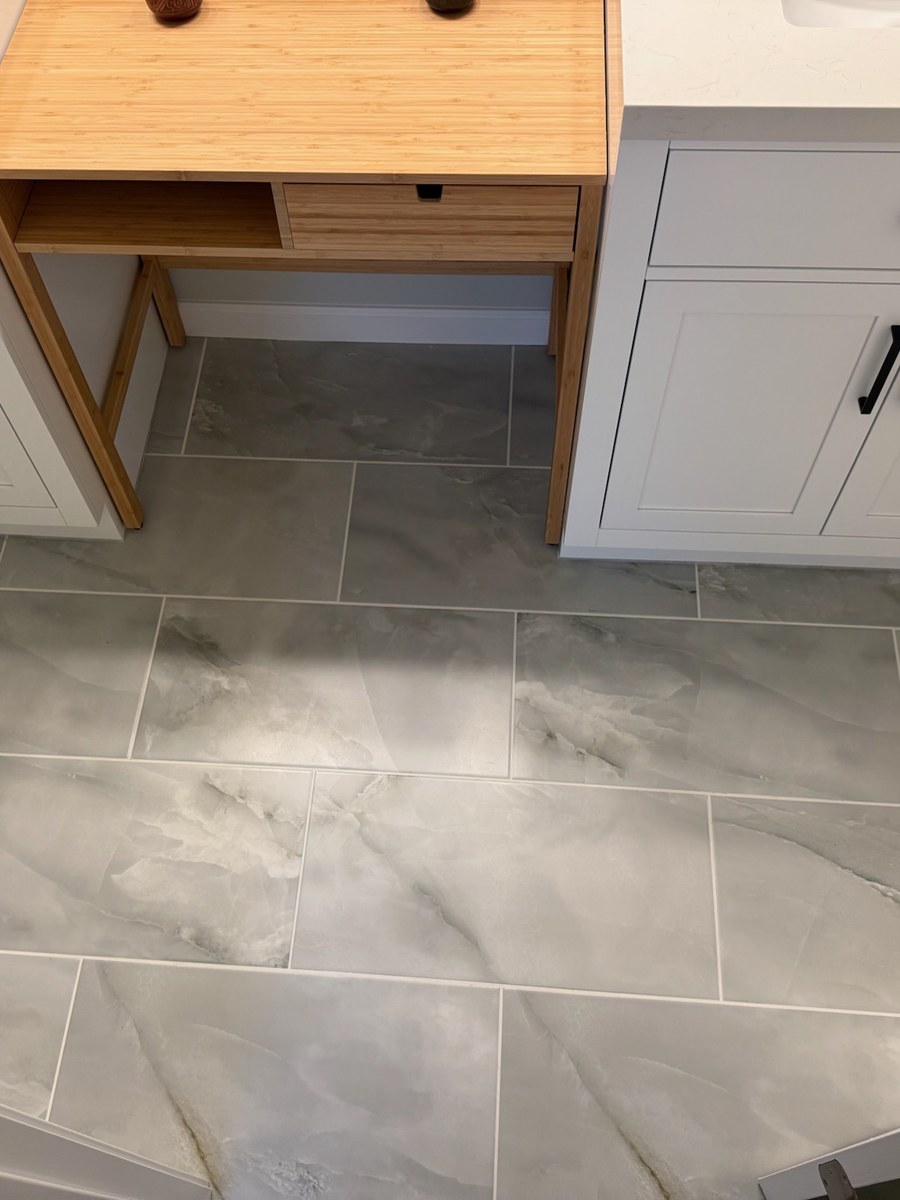
A 12 by 24 inch porcelain covers ground quickly and reads calm. Mosaics are the most expensive thing you can put on a floor because you are paying for hundreds of edges. The exception is a shower floor, where small tile is the right call for slope and slip resistance.
3. Spend the Money Where the Eye Lands
In a bathroom, the eye goes to the shower back wall and the vanity wall. In a kitchen, to the backsplash behind the range. Put the $18 tile there and a good $4 porcelain everywhere else. Nobody has ever admired the tile in a corner behind a door.
4. Use One Tile in Two Formats
Many collections offer the same body in a large floor format and a smaller wall or mosaic format. Same color story, one order, and it reads intentional rather than budget-driven.
5. Skip Decorative Trim, Use a Clean Edge
Bullnose and decorative liners date a bathroom faster than anything else and they cost money. A mitered edge or a simple metal profile is cleaner and usually cheaper.
6. Buy Enough the First Time
Running out mid-job means a second order, a different production lot, and a visible color shift. Order the waste percentage your installer asks for, and keep a box afterward for repairs. Dye lots do not come back.
Where Saving on Tile Goes Wrong
- Cheap grout in a family shower. Spend the small premium on a high-performance or epoxy grout. It is the difference between a shower that looks new in year five and one that does not.
- Skipping the waterproofing system. Never a place to save. Ever.
- Polished tile at an entry or a shower floor. A slip hazard, especially with Chicago winters tracked across it.
- Very large format on an uneven floor. Large tile requires a flat substrate. Skipping the leveling causes lippage, which is what you feel with a bare foot forever afterward.
- Buying tile before the installer sees the room. Some materials, especially natural stone and very thin large panels, need specific handling and substrate.
What Tile Work Costs Around Here
Standard porcelain floor, straight or offset layout: $12 to $20 per square foot installed, including setting material and basic prep.
Shower walls with a bonded waterproofing system: $25 to $45 per square foot installed, which reflects the assembly under the tile as much as the tile.
Kitchen backsplash: $18 to $35 per square foot installed, higher for stone slab or intricate patterns.
Heated floor mat under tile: $10 to $18 per square foot added, plus a thermostat.
The Trade-Off Table We Use With Clients
- Want the look of stone without the maintenance: porcelain that mimics marble, at a fraction of the price and none of the sealing.
- Want warmth underfoot: put the money in the heated mat, not the tile.
- Want a statement: one wall, one material, done well. Not four materials in one bathroom.
- Want it to last: grout and waterproofing, every time, before anything decorative.
Common Questions
Is porcelain better than ceramic?
Porcelain is denser, less absorbent, and better for floors and wet areas. Good ceramic is fine on walls. For anything underfoot or in a shower, porcelain.
Can I supply my own tile?
Usually, and we will tell you what to order and how much. The risk you take on is breakage, shortfall, and lead time, which become schedule problems rather than material problems.
Does expensive tile last longer?
Not necessarily. A $4 porcelain and a $20 porcelain can have identical durability. The premium usually buys appearance, size, and finish, not lifespan.
Important Cost Note
Ranges here are typical installed pricing in the Chicago suburbs and depend on substrate, layout, and access. At ADS the in-home consultation and the selection conversation are complimentary, including the part where we tell you the cheaper tile will look the same in the room.
Choosing Tile This Month?
If you are selecting tile for a project in Buffalo Grove, Arlington Heights, Glen Ellyn, Naperville, or a nearby Chicago suburb, bring the layout to the conversation, not just the sample. The pattern decision is worth more than the material decision.
At ADS Building & Remodeling, we provide:
- A complimentary design consultation and 3D rendering
- Tile priced into the contract with pattern and waste accounted for, no open allowances
- A fixed-price quote that doesn’t move after you sign
- One accountable team, waterproofing systems installed as designed, and a flood test before tile
The tile you choose is a look. The pattern, the grout, and the system underneath are the budget and the lifespan.